Elizabeth of the Trinity: “He Imparts Eternal Life To Me” Wednesday, Nov 25 2009 

Elizabeth of the Trinity

Her first retreat after her profession established her in this state of soul: the way of faith, obscure, yet luminous, because she clearly realized the love of God.

He was her light, enlightening her in the darkness of her night, so that she blessed the Lord at all times.

God appeared to wish to recompense her generous fidelity during this retreat, for she was overwhelmed with graces too sublime and substantial to be described, so that when Sister Elizabeth of the Trinity gave an account of her dispositions, she raised her lustrous eyes to her Prioress, and could only say: “He imparts eternal life to me.”

… After this retreat, her prayer seemed still more simple. “We must keep our eyes on Him,” she said, speaking of the Divine Master; “we must be silent; it is so simple!”

This was her one rule. If a novena was to be made, a feast to be prepared for, when she was asked what she was going to do, she always answered: “I am going to be silent, so that He may flow into me.”

…Sometimes, however, she felt very doubtful whether she ought to be constantly passive; ought she not to act more during prayer ?

Her peace, disturbed for the moment, was always restored to her by Him Who wished her to be thus recollected under His direct and continuous action.

One day, during the “Forty Hours,” Elizabeth, after listening to her companions urging one another to make reparation, felt rather sorry, as she began her prayer, at not being able to act in the same way; but she had hardly prostrated herself to adore our Lord, when He enveloped her with a luminous and peace-giving radiance.

It was suddenly revealed to her that the obstacle created by sin against God’s diffusing Himself into the souls of men was one of the things which most deeply wounded the Divine Heart, and that to console Him and to make reparation for such an outrage, she must let herself be taken possession of by God, giving full liberty to His grace and love to act within her.

Now that her form of prayer was divinely approved, it became more and more her habitual state of soul

Elizabeth of the Trinity (1880-1906); as recounted in The Praise of Glory: Reminiscences of Elizabeth of the Trinity by A Carmelite Nun of Dijon, pp. 110-111.

Macarius the Egyptian: If Christ does not Dwell in the Soul Wednesday, Nov 25 2009 

Macarius the Egyptian

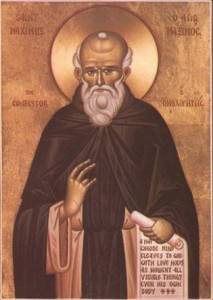
When God was displeased with the Jews, he delivered Jerusalem to the enemy, and they were conquered by those who hated them; there were no more sacrifices or feasts.

Likewise angered at a soul who had broken his commands, God handed it over to its enemies, who corrupted and totally dishonoured it.

When a house has no master living in it, it becomes dark, vile and contemptible, choked with filth and disgusting refuse.

So too is a soul which has lost its master, who once rejoiced there with his angels. This soul is darkened with sin, its desires are degraded, and it knows nothing but shame.

Woe to the path that is not walked on, or along which the voices of men are not heard, for then it becomes the haunt of wild animals. Woe to the soul if the Lord does not walk within it to banish with his voice the spiritual beasts of sin.

Woe to the house where no master dwells, to the field where no farmer works, to the pilotless ship, storm-tossed and sinking. Woe to the soul without Christ as its true pilot; drifting in the darkness, buffeted by the waves of passion, storm-tossed at the mercy of evil spirits, its end is destruction.

Woe to the soul that does not have Christ to cultivate it with care to produce the good fruit of the Holy Spirit. Left to itself, it is choked with thorns and thistles; instead of fruit it produces only what is fit for burning.

Woe to the soul that does not have Christ dwelling in it; deserted and foul with the filth of the passions, it becomes a haven for all the vices. When a farmer prepares to till the soil he must put on clothing and use tools that are suitable. So Christ, our heavenly king, came to till the soil of mankind devastated by sin.

He assumed a body and, using the cross as his ploughshare, cultivated the barren soul of man. He removed the thorns and thistles which are the evil spirits and pulled up the weeds of sin. Into the fire he cast the straw of wickedness.

And when he had ploughed the soul with the wood of the cross, he planted in it a most lovely garden of the Spirit, that could produce for its Lord and God the sweetest and most pleasant fruit of every kind.

Attributed to Macarius the Egyptian (c. 300 -391); from the Office of Readings, Wednesday in the 34th week of Ordinary Time.


Thomas Aquinas: The Whole Trinity Dwells in the Mind Tuesday, Nov 24 2009 

Thomas Aquinas

The whole Trinity dwells in the mind by sanctifying grace, according to Jn. 14:23: “We will come to him, and will make Our abode with him.”

The soul is made like to God by grace. Hence for a divine person to be sent to anyone by grace, there must needs be a likening of the soul to the divine person Who is sent, by some gift of grace.

Because the Holy Ghost is Love, the soul is assimilated to the Holy Ghost by the gift of charity: hence the mission of the Holy Ghost is according to the mode of charity.

Whereas the Son is the Word, not any sort of word, but one Who breathes forth Love. Hence Augustine says (De Trin. ix 10): “The Word we speak of is knowledge with love.”

Thus the Son is sent not in accordance with every and any kind of intellectual perfection, but according to the intellectual illumination, which breaks forth into the affection of love, as is said (Jn. 6:45): “Everyone that hath heard from the Father and hath learned, cometh to Me,” and (Ps. 38:4): “In my meditation a fire shall flame forth.”

Thus Augustine plainly says (De Trin. iv, 20): “The Son is sent, whenever He is known and perceived by anyone.”

Now perception implies a certain experimental knowledge; and this is properly called wisdom [sapientia], as it were a sweet knowledge [sapida scientia], according to Ecclus. 6:23: “The wisdom of doctrine is according to her name.”

Thomas Aquinas (1225-1274): Summa Theologiae Ia, q. 43, a. 5 [corpus and ad 2].


Lawrence of the Resurrection: Let Us Make Way For Grace Monday, Nov 23 2009 

Lawrence of the Resurrection

He [Lawrence] complains much of our blindness; and cries often that we are to be pitied who content ourselves with so little.

God, says he, has infinite treasure to bestow, and we take up with a little sensible devotion which passes in a moment.

Blind as we are, we hinder God, and stop the current of His graces. But when He finds a soul penetrated with a lively faith, He pours into it His graces and favours plentifully.

There they flow like a torrent, which, after being forcibly stopped against its ordinary course, when it has found a passage, spreads itself with impetuosity and abundance.

Yes, we often stop this torrent, by the little value we set upon it. But let us stop it no more. Let us enter into ourselves and break down the bank which hinders it. Let us make way for grace.

Let us redeem the lost time, for perhaps we have but little left. Death follows us close, let us be well prepared for it; for we die but once, and a miscarriage there is irretrievable.

I say again, let us enter into ourselves. The time presses: there is no room for delay; our souls are at stake. I believe you have taken such effectual measures, that you will not be surprised.

I commend you for it, it is the one thing necessary. We must, nevertheless, always work at it, because not to advance, in the spiritual life, is to go back.

But those who have the gale of the Holy Spirit go forward even in sleep. If the vessel of our soul is still tossed with winds and storms, let us awake the Lord, who reposes in it, and He will quickly calm the sea.

Lawrence of the Resurrection (1614-1691): Practice of the Presence of God.

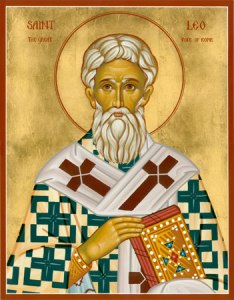
Leo the Great: Where your Treasure is, there also will your Heart be Monday, Nov 23 2009 

Leo the Great

For the man who loves God it is sufficient to please the one he loves; and there is no greater recompense to be sought than the loving itself; for love is from God by the very fact that God himself is love.

The good and chaste soul is so happy to be filled with him that it desires to take delight in nothing else. For what the Lord says is very true: Where your treasure is, there also will your heart be.

What is a man’s treasure but the heaping up of profits and the fruit of his toil? For as a man sows, so will he reap, and each man’s gain matches his toil; and where delight and enjoyment are found, there the heart’s desire is attached.

Now there are many kinds of wealth and a variety of grounds for rejoicing; every man’s treasure is that which he desires. If it is based on earthly ambitions, its acquisition makes men not blessed but wretched.

But those who enjoy the things that are above and eternal rather than earthly and perishable, possess an incorruptible, hidden store of which the prophet speaks: Our treasure and salvation have come, wisdom and instruction and piety from the Lord: these are the treasures of justice.

Through these, with the help of God’s grace, even earthly possessions are transformed into heavenly blessings; it is a fact that many people use the wealth which is either rightfully left to them or otherwise acquired, as a tool of devotion.

By distributing what might be superfluous to support the poor, they are amassing imperishable riches, so that what they have discreetly given cannot be subject to loss. They have properly placed those riches where their heart is; it is a most blessed thing to work to increase such riches rather than to fear that they may pass away.

Leo the Great (c.400-461): Sermon 92,2-3; from Office of Readings, Monday in 34th week of ordinary time.


Elizabeth of the Trinity: We Have Our Heaven Within Us Sunday, Nov 22 2009 

Elizabeth of the Trinity

My dear Mother, offer a few of your prayers for the little “House of God” [the name Elizabeth means House of God], that it may be completely filled by the Three”. I have entered into the soul of my Christ, where I am about to spend my Lent.

Ask Him to grant that I may live no more, but that He may live in me; that my union with Him may be closer every day, that I may fix my gaze upon the great Vision.

I think that is the secret of sanctity, and it is so simple. Only to think that we have our heaven within us, the heaven for which I sometimes feel so homesick!

What joy when the veil is drawn aside at last and we are face to face with Him Whom alone we love! Meanwhile I live in love, I plunge into it, and lose myself; it is infinite, the infinity for which my soul is thirsting.

…My life can be summed up in one word…It might be inscribed upon every moment of my time. It was St. Paul’s life, too: “for His exceeding charity”. Whatever happens to me is a message or an assurance of the exceeding love of God. I cannot live my life apart from that.

I believe that to reach the ideal life of the soul we must live in the supernatural, must realize that God dwells within the depths of our soul, and do all things with Him.

Then nothing can be trivial, however commonplace in itself, for we do not live in, but above, such things. A supernatural soul does not deal with secondary causes, but solely with God.

“God…for His exceeding charity wherewith He loved us” (Eph. ii. 4). How this simplifies our view of life! It resembles the existence of the blessed spirits, and the soul is freed from self and from all else.

All things are comprised in the one, and in the one thing necessary of which the Divine Master spoke to Magdalen. We become really great and free, for our will “is enclosed in the will of God”, as a mystic writer says.

Elizabeth of the Trinity (1880-1906); quoted in The Praise of Glory: Reminiscences of Elizabeth of the Trinity by A Carmelite Nun of Dijon, pp. 90-91.


Origen Adamantius: The Kingdom of God is Within Us Sunday, Nov 22 2009 

Origen

The kingdom of God, in the words of our Lord and Savior, does not come for all to see; nor shall they say: Behold, here it is, or behold, there it is; but the kingdom of God is within us, for the word of God is very near, in our moth and in our heart.

Thus it is clear that he who prays for the coming of God’s kingdom prays rightly to have it within himself, that there it might grow and bear fruit and become perfect. For God reigns in each of his holy ones.

Anyone who is holy obeys the spiritual laws of God, who dwells in him as in a well-ordered city. The Father is present in the perfect soul, and with him Christ reigns, according to the words: We shall come to him and make our home with him.

Thus the kingdom of God within us, as we continue to make progress, will reach its highest point when the Apostle’s words are fulfilled, and Christ, having subjected all his enemies to himself, will hand over his kingdom to God the Father, that God may be all in all.

Therefore, let us pray unceasingly with that disposition of soul which the Word may make divine, saying to our Father who is in heaven: Hallowed be your name; your kingdom come.

Note this too about the kingdom of God. It is not a sharing of justice with iniquity, nor a society of light with darkness, nor a meeting of Christ with Belial. The kingdom of God cannot exist alongside the reign of sin.

Therefore, if we wish God to reign in us, in no way should sin reign in our mortal body; rather we should mortify our members which are upon the earth and bear fruit in the Spirit.

There should be in us a kind of spiritual paradise where God may walk and be our sole ruler with his Christ. In us the Lord will sit at the right hand of that spiritual power which we wish to receive. And he will sit there until all his enemies who are within us become his footstool, and every principality, power and virtue in us is cast out.

All this can happen in each one of us, and the last enemy, death, can be destroyed; then Christ will say in us: O death, where is your sting? O hell, where is your victory?

And so what is corruptible in us must be clothed with holiness and incorruptibility; death will be cast out, and our mortality will be clad with the Father’s immortality, so that, as God reigns in us, we may truly enjoy the blessings of rebirth and resurrection.

Origen Adamantius (c.185-254): Notebook On Prayer (Cap. 25: PG 11, 495-499); used in the Roman Office of Readings for the Feast of Christ the King.


John Eudes: Christ Fulfills His Interior Life In Us Friday, Nov 20 2009 

John Eudes

We must strive to follow and fulfill in ourselves the various stages of Christ’s plan as well as his mysteries, and frequently beg him to bring them to completion in us and in the whole Church. For the mysteries of Jesus are not yet completely perfected and fulfilled.

They are complete, indeed, in the person of Jesus, but not in us, who are his members, nor in the Church, which is his mystical body. The Son of God wills to give us a share in his mysteries and somehow to extend them to us. He wills to continue them in us and in his universal Church.

This is brought about first through the graces he has resolved to impart to us and then through the works he wishes to accomplish in us through these mysteries. This is his plan for fulfilling his mysteries in us.

For this reason Saint Paul says that Christ is being brought to fulfillment in his Church and that all of us contribute to this fulfillment, and thus he achieves the fullness of life, that is, the mystical stature that he has in his mystical body, which will reach completion only on judgement day. In another place Paul says: I complete in my own flesh what is lacking in the sufferings of Christ.

This is the plan by which the Son of God completes and fulfills in us all the various stages and mysteries. He desires us to perfect the mystery of his incarnation and birth by forming himself in us and being reborn in our souls through the blessed sacraments of baptism and the eucharist. He fulfills his interior life in us, hidden with him in God.

He intends to perfect the mysteries of his passion, death and resurrection, by causing us to suffer, die and rise again with him and in him. Finally, he wishes to fulfill in us the state of his glorious and immortal life, when he will cause us to live a glorious, eternal life with him and in him in heaven.

In the same way he would complete and fulfill in us and in his Church his other stages and mysteries. He wants to give us a share in them and to accomplish and continue them in us.

So it is that the mysteries of Christ will not be completed until the end of time, because he has arranged that the completion of his mysteries in us and in the Church will only be achieved at the end of time.

St John Eudes (1601-1680): second reading from the Office of Readings for August 19th, taken from the saint’s treatise on the Kingdom of Jesus.


Teresa Benedicta of the Cross: Christ’s High-Priestly Prayer and the Interior Life (3) Wednesday, Nov 18 2009 

Teresa Benedicta of the Cross

The Savior’s high priestly prayer unveils the mystery of the inner life: the circumincession of the Divine Persons and the indwelling of God in the soul.

In these mysterious depths the work of salvation was prepared and accomplished itself in concealment and silence. And so it will continue until the union of all is actually accomplished at the end of time. The decision for the Redemption was conceived in the eternal silence of the inner divine life.

The power of the Holy Spirit came over the Virgin praying alone in the hidden, silent room in Nazareth and brought about the Incarnation of the Savior. Congregated around the silently praying Virgin, the emergent church awaited the promised new outpouring of the Spirit that was to quicken it into inner clarity and fruitful outer effectiveness.

In the night of blindness that God laid over his eyes, Saul awaited in solitary prayer the Lord’s answer to his question, “What do you want me to do?” In solitary prayer Peter was prepared for his mission to the Gentiles.

And so it has remained all through the centuries. In the silent dialogue with their Lord of souls consecrated to God, the events of church history are prepared that, visible far and wide, renew the face of the earth.

The Virgin, who kept every word sent from God in her heart, is the model for such attentive souls in whom Jesus’ high priestly prayer comes to life again and again. And women who, like her, were totally self-forgetful because of being steeped in the life and suffering of Christ, were the Lord’s preferred choice as instruments to accomplish great things in the church: a St. Bridget, a Catherine of Siena.

And when St. Teresa, the powerful reformer of her Order at a time of widespread falling away from the faith, wished to come to the rescue of the church, she saw the renewal of true interior life as the means toward this end.

St Teresa Benedicta of the Cross (1892-1942): Before the Face of God

Teresa Benedicta of the Cross: Christ’s High-Priestly Prayer and the Interior Life (2) Wednesday, Nov 18 2009 

Teresa Benedicta of the Cross

Once a year on the greatest and most holy day of the year, on the Day of Atonement, the high priest stepped into the Holy of Holies before the face of the Lord “to pray for himself and his household and the whole congregation of Israel.”

He sprinkled the throne of grace with the blood of a young bull and a goat, which he had previously to slaughter, and in this way absolved himself and his house “of the impurities of the sons of Israel and of their transgressions and of all their sins.”

No person was to be in the tent (i.e., in the holy place that lay in front of the Holy of Holies) when the high priest stepped into God’s presence in this awesomely sacred place, this place where no one but he entered and he himself only at this hour. And even now he had to burn incense “so that a cloud of smoke…would veil the judgment throne…and he not die.” This solitary dialogue took place in deepest mystery.

The Day of Atonement is the Old Testament antecedent of Good Friday. The ram that is slaughtered for the sins of the people represents the spotless Lamb of God (so did, no doubt, that other chosen by lot and burdened with the sins of the people that was driven into the wilderness). And the high priest descended from Aaron foreshadows the eternal high priest.

Just as Christ anticipated his sacrificial death during the last supper, so he also anticipated the high priestly prayer. He did not have to bring for himself an offering for sin because he was without sin. He did not have to await the hour prescribed by the Law and nor to seek out the Holy of Holies in the temple.

He stands, always and everywhere, before the face of God; his own soul is the Holy of Holies. It is not only God’s dwelling, but is also essentially and indissolubly united to God. He does not have to conceal himself from God by a protective cloud of incense. He gazes upon the uncovered face of the Eternal One and has nothing to fear.

Looking at the Father will not kill him. And he unlocks the mystery of the high priest’s realm. All who belong to him may hear how, in the Holy of Holies of his heart, he speaks to his Father; they are to experience what is going on and are to learn to speak to the Father in their own hearts.

St Teresa Benedicta of the Cross (1892-1942): Before the Face of God

Next Page »