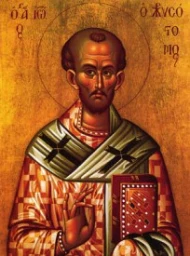
John Chrysostom: The Compassion and Sympathy of Christ Wednesday, Jan 16 2013 

John_Chrysostom“For verily He taketh not hold of Angels, but of the seed of Abraham” (Hebrews 2:16).

Why did he not say, “He took on Him,” but used this expression, “He takes hold of”?

It is derived from the figure of persons pursuing those who turn away from them, and doing everything to overtake them as they flee, and to take hold of them as they are bounding away.

For when human nature was fleeing from Him, and fleeing far away (for we “were far off”— Eph. 2:13 ), He pursued after and overtook us.

He showed that He has done this only out of kindness, and love, and tender care.

[...] “Wherefore it behooved Him in all things to be made like unto His brethren” (2:16-17).

What is this, “in all things”? He was born, was brought up, grew, suffered all things necessary, at last He died. This is, “in all things to be made like unto His brethren.”

[...] And consider…how St Paul represents Him as having great zeal “to be made like unto us”: which was a sign of much care.

[...] For this cause did He leave the angels and the other powers, and come down to us, and took hold of us, and wrought innumerable good things.

He destroyed Death, He cast out the devil from his tyranny, He freed us from bondage: not by brotherhood alone did He honour us, but also in other ways beyond number.

For He was willing also to become our High Priest with the Father: for he adds, “That He might become a merciful and faithful High Priest in things pertaining to God.”

For this cause…He took on Him our flesh, only for Love to man, that He might have mercy upon us. For neither is there any other cause of the economy, but this alone.

For He saw us, cast on the ground, perishing, tyrannized over by Death, and He had compassion on us.

[...] We were become altogether enemies to God…;  condemned, degraded, there was none who should offer sacrifice for us.

He saw us in this condition, and had compassion on us, not appointing a High Priest for us, but Himself becoming a High Priest…“to make reconciliation for the sins of the people. That He might be a merciful and faithful High Priest.”

[...] In order then that He might offer a sacrifice able to purify us, for this cause He has become man.

[...] He went through the very experience of the things which we have suffered…; He suffered much, He knows how to sympathize.

[...] He knows what tribulation is; He knows what temptation is, not less than we who have suffered, for He Himself also has suffered…. He will stretch forth His hand with great eagerness, He will be sympathizing.

John Chrysostom (c.347-407): Homily 5, 1-2 on the Epistle to the Hebrews.

John Chrysostom: “To Fulfil Every Righteousness” Wednesday, Jan 9 2013 

John_ChrysostomFor whom was Jesus baptised, if this was done not for repentance, nor for the remission of sins, nor for receiving the gifts of the Spirit?

[...] When John said: I have need to be baptised of Thee, and Thou art come to me?—He answered thus: Stay now, for thus it becometh us to fulfil every righteousness (Matthew 3:14-15).

[...] What does He mean: To fulfill every righteousness? By righteousness is meant the fulfillment of all the commandments, as is said: Both were righteous, walking faultlessly in the commandments of the Lord (Luke 1:6).

Since fulfilling this righteousness was necessary for all people, but no one of them kept it or fulfilled it, Christ came then and fulfilled this righteousness.

And what righteousness is there, someone will say, in being baptised? Obedience for a prophet was righteous.

As Christ was circumcised, offered sacrifice, kept the sabbath and observed the Jewish feasts, so also He added this remaining thing, that He was obedient to having been baptised by a prophet.

[...] If obedience to God constitutes righteousness, and God sent John to baptise the nation, then Christ has also fulfilled this along with all the other commandments.

Consider, that the commandments of the law is the main point of the two denarii (see Luke 10:35). The human race needed to pay this debt [i.e. observing the commandments] but did not pay it…, and so is embraced by death. Christ…paid the debt…and seized from it those who were not able to pay.

Wherefore He does not say: It is necessary for us to do this or that, but rather, To fulfill every righteousnessIt is for Me, being the Master, says He, proper to make payment for the needy.

[...] Wherefore also the Spirit did descend as a dove: because where there is reconciliation with God, there also is the dove.

So also in the ark of Noah the dove did bring the branch of olive—a sign of God’s love of mankind and of the cessation of the flood.

And now in the form of a dove, and not in a body…the Spirit descended, announcing the universal mercy of God and showing with it, that the spiritual man needs to be gentle, simple and innocent, as Christ also says: Except ye be converted and become as children, you shall not enter into the Heavenly Kingdom (Mt 18:3).

But that ark, after the cessation of the flood, remained upon the earth; this ark, after the cessation of wrath, is taken to heaven, and now this Immaculate and Imperishable Body is situated at the right hand of the Father.

John Chrysostom (c.347-407): Discourse on the Day of the Baptism of Christ @ Pravoslavie.

John Chrysostom: To Forgive not Merely with the Lips, but from the Heart Tuesday, Nov 13 2012 

God requires two things of us here: to condemn ourselves for our sins, and to forgive others.

And we are to do the former for the sake of the latter, that this may become easier (for he who considers his own sins is more indulgent to his fellow-servant).

And we are to forgive not merely with the lips, but from the heart.

Let us not then thrust the sword into ourselves by being revengeful.

For what grief has he who has grieved you inflicted upon you which is as bad as that which you will work unto yourself by keeping your anger in mind, and drawing upon yourself the sentence from God to condemn you?

If you are watchful, and keep yourself under control, the evil will come round upon his head, and it will be he that will suffer harm.

But if you should carry on being indignant and displeased, then you yourself will undergo the harm – not from him, but from yourself.

Say not then that he insulted you, and slandered you, and did unto you ills beyond number; for the more you say, so much the more do you declare him a benefactor.

For he has given you an opportunity to wash away your sins – so that the greater the injuries he has done you, so much more has he become for you a cause of a greater remission of sins.

For if we be willing, no one shall be able to injure us, but even our enemies shall benefit us in the greatest degree.

And why do I speak of men? For what can be more wicked than the devil? Yet nevertheless, even hence have we a great opportunity of approving ourselves, as the case of Job shows us.

But if even the devil has become a cause of obtaining crowns, why are you afraid of a man as an enemy?

See then how much you gain, bearing meekly the spiteful acts of your enemies.

First and greatest, you obtain deliverance from sins;

secondly, fortitude and patience;

thirdly, mildness and benevolence;

[...] fourthly, to be free from anger continually, to which nothing can be equal.

For of him that is free from anger, it is quite clear that he is delivered also from the despondency arising from anger, and will not spend his life on vain labours and sorrows.

For he that does not know how to hate, likewise does not know how to grieve, but will enjoy pleasure, and ten thousand blessings.

Accordingly, we punish ourselves by hating others, even as on the other hand we benefit ourselves by loving them.

John Chrysostom (c.347-407): Homily 61,5 on St Matthew’s Gospel.

John Chrysostom: Prayer – an Eternal Longing for the Lord, which Sets the Heart Ablaze as with a Mighty Fire Saturday, Sep 29 2012 

Prayer is the height of our blessings and communion with God; for it is both companionship and unity with God.

Just as the eyes of the body are enlightened when they look upon light, so a soul intent on God is illumined and enlightened by his inexpressible light.

It is not indeed formal prayer that I refer to, but prayer offered from the heart, and so not confined to suitable times and fixed intervals, but continuing in action without cease day and night.

For we do not only have to withdraw to pray, and suddenly turn our minds towards God.

No, even while we are busy among the needy, either with the care of the poor or with other concerns, or useful good works – into their very midst we should also bring our desire for and remembrance of God, so that seasoned, as it were, with the love of God they may provide a most acceptable offering for the Lord of all men.

If we devote most of our time to prayer, the delight we can gain from it will last us the whole of our lives.

Prayer is illumination of the soul and true knowledge of God.

It mediates between God and men; it heals suffering and counter­acts disease.

It calms the soul and guides it to heaven, for prayer has no earthly life, but follows a path leading to the very heights of heaven.

It transcends the created world, and in the spirit cuts through and soars above the air.

It passes beyond the circle of stars, opens the gates of heaven, and taking precedence over the angels enters the very presence of the unapproachable Trinity.

There it worships the deity, and is held worthy to be the companion of the king of heaven. The soul, raised by it high into heaven, embraces the Lord in an ineffable embrace, and cries out tearfully like a child to its mother, begging for the heavenly milk.

It seeks its own desires, and receives gifts surpassing all that belongs to the world of nature.

Now in speaking of prayer, you must not imagine that I mean words.

I mean desire for God, unutterable love, which men cannot offer of themselves but by the inspiration of divine grace.

Of this the Apostle says: We do not know how we ought to pray, but in our wordless sighs the Spirit himself intercedes for us.

If the Lord grants to anyone prayer of this kind; it is wealth that will never be taken away, and heavenly food that satisfies the soul.

He who tastes it is possessed with an eternal longing for the Lord, which sets his heart ablaze as with a mighty fire.

John Chrysostom (c.347-407):On Prayer 6 (PG 64:462.466); from the Monastic Office of Vigils, Sunday of the 26th Week of Ordinary Time, Year 2.

John Chrysostom: Glorying in the Cross of Our Lord Jesus Christ Friday, Sep 14 2012 

But far be it from me to glory, save in the Cross of our Lord Jesus Christ (Galatians 6:14).

Truly this symbol [the Cross] is thought despicable; but it is so in the world’s reckoning, and among men; in Heaven and among the faithful it is the highest glory.

Poverty too is despicable, but it is our boast; and to be cheaply thought of by the public is a matter of laughter to them, but we are elated by it. So too is the Cross our boast.

[...] And what is the boast of the Cross? That Christ for my sake took on Him the form of a slave, and bore His sufferings for me the slave, the enemy, the unfeeling one; yea He so loved me as to give Himself up to a curse for me.

What can be comparable to this! If servants who only receive praise from their masters, to whom they are akin by nature, are elated thereby, how must we not boast when the Master who is very God is not ashamed of the Cross which was endured for us.

Let us then not be ashamed of His unspeakable tenderness; He was not ashamed of being crucified for thy sake, and wilt thou be ashamed to confess His infinite solicitude?

It is as if a prisoner who had not been ashamed of his King, should, after that King had come to the prison and himself loosed the chains, become ashamed of him on that account.

Yet this would be the height of madness, for this very fact would be an especial ground for boasting.

 Paul adds:“Through which the world hath been crucified unto me, and I unto the world.”

What he here calls the world is not the heaven nor the earth, but the affairs of life, the praise of men, retinues, glory, wealth, and all such things as have a show of splendor.

“To me these things are dead.” A Christian should always think like this, and should always use this language.

Nor was Paul content with the former putting to death, but added another, saying, “and I unto the world,” thus implying a double putting to death, and saying, They are dead to me, and I to them, neither can they captivate and overcome me, for they are dead once for all, nor can I desire them, for I too am dead to them.

Nothing can be more blessed than this putting to death, for it is the foundation of the blessed life.

John Chrysostom (c.347-407): Commentary on Galatians 6:14.

John Chrysostom: In All That Happens Let Us Rejoice and Give Thanks to the Benevolent God Saturday, Jul 21 2012 

Consider the story of Job, and how, after the loss of his wealth and the destruction of his herds, not one, two or even three of his children were taken from him, but all of them together in the very flower of their youth.

When you hear of his great spiritual courage, even if you are the weakest of men, it is not so difficult to recover yourself and return to life.

For you, my friend, at least watched over your sick child as he lay on his bed, you heard his last words and attended him as his life came to an end, you shut his eyes and closed his mouth.

But Job was not present at his children’s death, nor saw them dying in the house where all were buried as in a single tomb.

Yet after such overwhelming disasters he neither grieved nor despaired, but said: The Lord gave, and the Lord has taken away; it has been done as the Lord willed. Blessed be the name of the Lord for ever.

Let us too utter these words in every misfortune that life brings us, be it loss of wealth, bodily sickness, abuse, slander, or any other human ill.

Let us say: The Lord gave, and the Lord has taken away; it has been done as the Lord willed. Blessed be the name of the Lord for ever.

If we make this our philosophy, no misfortune will ever cause us suffering, however many we endure.

The gain will always be greater than the loss, and the good will outweigh the bad, since with these words you attract the favour of God and shake off the tyranny of the devil.

For as soon as you utter them, the devil at once takes to flight, and when he has gone the cloud of dejection lifts too and oppressive thoughts disappear in the company of their master; and besides all this you will have as your reward all the blessings both of earth and of heaven.

You have a steadfast example in Job and also in the Apostles, who scorned the terrors of this world for God’s sake, and so gained the blessings of eternity.

Let us then follow them, and in all that happens to us rejoice and give thanks to the benevolent God.

So shall we pass this present life in contentment and gain the blessings to come, by the grace and kindness of our Lord Jesus Christ.

John Chrysostom (c.347-407): Homily on the paralytic who was Let Down through the Roof (PG 51:62-63); from the Monastic Office of Vigils, Monday of the Fifteenth Week of Ordinary Time, Year 2.

John Chrysostom: “The Lord has Done Great Things for Us” Sunday, Jun 17 2012 

When the Lord returned the captives to Zion, we were like people who are comforted.

If it was a comfort for them to be released from a barbaric nation, how much more should we not be glad and leap for joy at being set free from sin, and preserve that joy always, never destroying or disturbing it by falling again into the same faults?

Then our mouths were filled with joy and our tongues with gladness. Then they will say among the nations: the Lord has done great things for them. The Lord has done great things for us.

To rejoice at deliverance from captivity helps not a little to inspire people with nobler sentiments. But who, you may ask, would not rejoice at this? The ancestors of these people did not.

When they were released from Egypt and set free from slavery, they were so un­grateful that in the midst of all their benefits they did nothing but grumble, and were angry and embittered and perpetually dis­traught.

But we are not like that, says the psalmist; we leap for joy.

Let us learn the reason for their joy. We do not only rejoice, they say, because of our deliverance from terrible suffering, but because it will make the whole world know God’s care for us.

For as the psalmist says: Then they will say among the nations: The Lord has done great things for them. The Lord has done great things for us.

There is no repetition here; the words are meant to describe their joy. The first saying is that of the nations, the second is their own.

Notice this too: they did not say ‘He saved us’, or ‘He delivered us’, but ‘He did great things for us’, for they wanted to show the incredible event in all its wonder.

Can you not see that this people gave a lesson to the whole world when they were carried off into captivity as well as when they returned? For their return preached its own message.

News of them went round everywhere and made God’s love for humankind known to everyone, because the wonderful things he had done for them were truly great and incredible.

Cyrus himself, who had them in his power, set them free without anyone asking him because God made him relent.

John Chrysostom (c.347-407): Homilies on Psalm 125,1; from the Monastic Office of Vigils, Sunday of the Eleventh Week of Ordinary Time, Year 2.

John Chrysostom: Communion in the Body and Blood of Christ Thursday, Jun 7 2012 

The cup of blessing which we bless, is it not a communion in the blood of Christ?

Do you seek, blessed Paul, to rouse your hearer to a sense of reverence when you mention tremendous mysteries, and call this fearful and awe-inspiring cup a cup of blessing?

Yes, he replies…. When I speak of blessing, I mean to unfold the whole treasure of God’s goodness to us, and call to mind his wonderful gifts.

It is in gratitude for these and all other such blessings that we approach the Sacrament.

[...] The cup of blessing which we bless, is it not a communion in the blood of Christ? What great confidence and awe there is in these words!

Paul means that in the cup is the same blood that flowed from Christ’s side, and it is that of which we partake.

He called it a cup of blessing because, when we hold it in our hands, we raise our hearts to God in wonder and amazement at his unspeakable gift.

We praise him because Christ shed this very blood so that we might not remain in error; and not only did he shed his blood, but he gave all of us a share of it.

The bread which we break, is it not a communion in the body of Christ?

The Apostle did not say ‘a participation’, because he wanted to signify something more than this.

For when we communicate it is not merely a matter of sharing and partaking, but of being united.

In the same way as a body was united with Christ, so we are united with him by this bread.

But why did he add, which we break? This we can see is done at the Eucharist, but it was not so on the Cross; rather the contrary, for Scripture says: Not a bone of his shall be broken.

But although he did not suffer this on the Cross, he suffers it now in his offering on your behalf; he allows himself to be broken so that all may be filled.

Paul used the phrase: a communion in the body; but there is a difference between communicants and the body we receive in communion, and so he set about removing even this distinction, small as it might seem.

For after he had spoken of a communion in the body, he still sought to define his meaning more accurately, and therefore added, Because there is one bread, we although many are one body.

John Chrysostom (c.347-407): Homilies on The Epistles to the Corinthians 24.1-2 (PG 61:199-201); from the Monastic Office of Vigils, Sunday of the Seventh Week of Ordinary Time, Year I.

John Chrysostom: Why Do We Fast? Saturday, Feb 25 2012 

During this Lenten season each of the faithful would undergo a thorough purification by means of prayer, almsgiving, fasting, watching, repentant tears, confession, and every other remedial measure.

Then when they had done all in their power to cleanse their consciences, they could approach the sacraments.

It is certain that the fathers did well to use such lenience in their desire to establish us in the habit of fasting.

As we know, we could proclaim a fast throughout the whole year, and no one would pay any attention.

But now, with a set time for fasting of only forty days, even the most sluggish need no exhortation to rouse themselves to undergo it; they accept it as a regular observance and recurring encouragement.

So, when someone asks you why you fast, you should not answer: because of the Passover, or because of the Cross. Neither of these is the reason for our fasting.

We fast because of our sins, since we are preparing to approach the sacred mysteries.

Moreover, the Christian Passover is a time for neither fasting nor mourning, but for great joy, since the Cross destroyed sin and made expiation for the whole world.

It reconciled ancient enmities and opened the gates of heaven.

It made friends of those who had been filled with hatred, restoring them to the citizenship of heaven.

Through the Cross our human nature has been set at the right hand of the throne of God, and we have been granted countless good things besides.

Therefore we must not give way to mourning or sadness; we must rejoice greatly instead over all these blessings.

Listen to the exultant words of Saint Paul: God forbid that I should boast of anything but the Cross of our Lord Jesus Christ.

And elsewhere he writes: God shows his own love for us because when we were still sinners Christ died for our sake.

Saint John’s message is the same. God loved the world so much, he declares, and then, passing over every other manifestation of God’s love, he comes at once to the crucifixion.

God loved the world so much that he gave his only Son, that is, he gave him up to be crucified, so that those who believed in him might not perish but might have eternal life.

If, then, the Cross has its foundation in love and is our glory, we must not say we mourn because of the Cross.

Far from it. What we have to mourn over is our own sinfulness, and that is why we fast.

John Chrysostom (c.347-407): Oratio 3 Adversus Iudaeos (PG 48, 867-868);  from the Monastic Office of Vigils, Ash Wednesday, Year 2.

John Chrysostom: In Being Loved by Christ, St Paul Thought of Himself as Possessing Life Wednesday, Jan 25 2012 

Paul, more than anyone else, has shown us what man really is, and in what our nobility consists, and of what virtue this particular animal is capable.

Each day he aimed ever higher; each day he rose up with greater ardor and faced with new eagerness the dangers that threatened him.

He summed up his attitude in the words: “I forget what is behind me and push on to what lies ahead.”

When he saw death imminent, he bade others share his joy: “Rejoice and be glad with me!”

And when danger, injustice and abuse threatened, he said: “I am content with weakness, mistreatment and persecution.”

These he called the weapons of righteousness, thus telling us that he derived immense profit from them.

Thus, amid the traps set for him by his enemies, with exultant heart he turned their every attack into a victory for himself.

Constantly beaten, abused and cursed, he boasted of it as though he were celebrating a triumphal procession and taking trophies home, and offered thanks to God for it all: “Thanks be to God who is always victorious in us!”

This is why he was far more eager for the shameful abuse that his zeal in preaching brought upon him than we are for the most pleasing honors, more eager for death than we are for life, for poverty than we are for wealth.

He yearned for toil far more than others yearn for rest after toil. The one thing he feared, indeed dreaded, was to offend God; nothing else could sway him. Therefore, the only thing he really wanted was always to please God.

The most important thing of all to him, however, was that he knew himself to be loved by Christ.

Enjoying this love, he considered himself happier than anyone else; were he without it, it would be no satisfaction to be the friend of principalities and powers.

He preferred to be thus loved and be the least of all, or even to be among the damned, than to be without that love and be among the great and honored.

To be separated from that love was, in his eyes, the greatest and most extraordinary of torments; the pain of that loss would alone have been hell, and endless, unbearable torture.

So too, in being loved by Christ he thought of himself as possessing life, the world, the angels, present and future, the kingdom, the promise and countless blessings.

Apart from that love nothing saddened or delighted him; for nothing earthly did he regard as bitter or sweet.

John Chrysostom (c.347-407): Homily 2 on the Praises of St Paul, from the Office of Readings for the Feast of the Conversion of Saint Paul on January 25 @ Crossroads Initiative.

Next Page »

Follow

Get every new post delivered to your Inbox.

Join 149 other followers