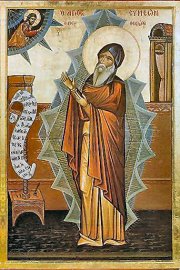
John Climacus: Love is a Resemblance to God Sunday, Apr 14 2013 

ClimacusHe who wishes to speak about divine love undertakes to speak about God. But it is precarious to expatiate on God, and may even be dangerous for the unwary.

The angels know how to speak about love, and even they can only do this according to the degree of their enlightenment.

God is love. So he who wishes to define this, tries with bleary eyes to measure the sand in the ocean.

Love, by reason of its nature, is a resemblance to God, as far as that is possible for mortals; in its activity it is inebriation of the soul; and by its distinctive property it is a fountain of faith, an abyss of patience, a sea of humility.

Love is essentially the banishment of every kind of contrary thought for love thinks no evil.

Love, dispassion and adoption are distinguished as sons from one another by name, and name only.

Just as light, fire and flame combine to form one power, it is the same with love, dispassion and adoption.

As love wanes, fear appears; because he who has no fear is either filled with love or dead in soul.

There is nothing wrong in representing desire, and fear, and care and zeal and service and love for God in images borrowed from human life.

Blessed is he who has obtained such love and yearning for God as an enraptured lover has for his beloved.

Blessed is he who fears the Lord as much as men under trial fear the judge. Blessed is he who is as zealous with true zeal as a well-disposed slave towards his master.

Blessed is he who has become as jealous of the virtues as husbands who remain in unsleeping watch over their wives out of jealousy.

Blessed is he who stands in prayer before the Lord as servants stand before a king. Blessed is he who unceasingly strives to please the Lord as others try to please men.

Even a mother does not so cling to the babe at her breast as a son of love clings to the Lord at all times.

He who truly loves ever keeps in his imagination the face of his beloved, and there embraces it tenderly.

Such a man can get no relief from his strong desire even in sleep, even then he holds converse with his loved one. So it is with our bodily nature; and so it is in spirit.

One who was wounded with love said of himself (I wonder at it): I sleep because nature requires this, but my heart is awake in the abundance of my love.

John Climacus (c.575-c.650): The Ladder of Divine Ascent, step 30, 4-13, translated by Archimandrite Lazarus Moore (Harper & Brothers, 1959) @ Prudence True.

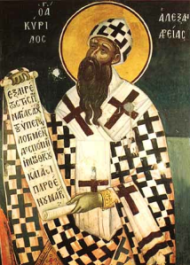
Fulgentius of Ruspe: The Love that Brought Christ from Heaven to Earth Raised Stephen from Earth to Heaven Wednesday, Dec 26 2012 

SaintfulgentiusYesterday our king, clothed in his robe of flesh, left his place in the virgin’s womb and graciously visited the world.

Today his soldier leaves the tabernacle of his body and goes triumphantly to heaven.

Our king, despite his exalted majesty, came in humility for our sake; yet he did not come empty-handed.

He brought his soldiers a great gift that not only enriched them but also made them unconquerable in battle, for it was the gift of love, which was to bring men to share in his divinity.

[...] And so the love that brought Christ from heaven to earth raised Stephen from earth to heaven; shown first in the king, it later shone forth in his soldier.

Love was Stephen’s weapon by which he gained every battle, and so won the crown signified by his name.

His love of God kept him from yielding to the ferocious mob; his love for his neighbor made him pray for those who were stoning him.

Love inspired him to reprove those who erred, to make them amend; love led him to pray for those who stoned him, to save them from punishment.

Strengthened by the power of his love, he overcame the raging cruelty of Saul and won his persecutor on earth as his companion in heaven.

In his holy and tireless love he longed to gain by prayer those whom he could not convert by admonition.

Now at last, Paul rejoices with Stephen, with Stephen he delights in the glory of Christ, with Stephen he exalts, with Stephen he reigns.

Stephen went first, slain by the stones thrown by Paul, but Paul followed after, helped by the prayer of Stephen.

This, surely, is the true life, my brothers, a life in which Paul feels no shame because of Stephen’s death, and Stephen delights in Paul’s companionship, for love fills them both with joy.

It was Stephen’s love that prevailed over the cruelty of the mob, and it was Paul’s love that covered the multitude of his sins; it was love that won for both of them the kingdom of heaven.

Love, indeed, is the source of all good things; it is an impregnable defense,- and the way that leads to heaven.

He who walks in love can neither go astray nor be afraid: love guides him, protects him, and brings him to his journey’s end.

My brothers, Christ made love the stairway that would enable all Christians to climb to heaven.

Hold fast to it, therefore, in all sincerity, give one another practical proof of it, and by your progress in it, make your ascent together.

Fulgentius of Ruspe (462/467—527/533):Sermon 3, 1-3, 5-6 (CCL 91A, 905-909) from the Office of Readings for the Feast of St Stephen, December 26th@ Crossroads Initiative.

John of Kronstadt: Love Calms and Agreeably Expands the Heart and Vivifies It Sunday, Dec 16 2012 

John_of_KronstadtOur soul is, so to say, a reflection of God’s countenance, and the brighter this reflection is, the clearer and calmer is the soul; and the less bright this reflection is, the darker, the more disturbed is the soul.

And as our soul is our heart it is necessary that every truth of God should be reflected in it through feeling, through gratitude, and that there should be no reflection in it of any lie.

Feel God’s love in the most pure mysteries, feel the truth of all prayers. Our heart is a mirror; as the objects of the outer world are reflected in an ordinary mirror, so ought the truth to be reflected with all exactitude in our hearts.

It is good, very good indeed, to be virtuous; the virtuous man is at peace himself, is pleasing to God and agreeable to other people.

The virtuous man involuntarily attracts everyone’s attention. Why is it so? Because fragrance involuntarily attracts attention and makes everyone wish to breathe it.

[...] Pay attention to his speech; from it there comes still greater fragrance: here you are as if face to face with his soul, and are enraptured with his sweet converse.

Love calms and agreeably expands the heart and vivifies it, whilst hatred painfully contracts and disturbs it.

Those who hate others torture and tyrannise over themselves; therefore they are the most foolish of the foolish ones.

[...] There are innumerable and various ways by means of which the Devil enters into our soul and removes it from God, pressing upon it with all his being, dark, hateful, and destroying.

[...]  Likewise there are innumerable and various ways for the Holy Ghost to enter it: the way of sincere faith, of true humility, of love to God and to our neighbour, and so on.

But, to our misfortune, the destroyer of men from time immemorial makes every effort to obstruct, by all possible means, all these ways for the Holy Ghost to enter the soul.

The most usual way to God for us sinners, who have strayed from Him into a far-away land, is the way of painful suffering and bitter tears.

Both the Holy Scriptures and actual experience testify that, in order to draw near to God, it is necessary for the sinner to suffer, weep, shed tears, and to amend his deceitful heart: “Draw nigh to God …. be afflicted, and mourn, and weep.”

Tears have power to cleanse the wickedness of our heart, and sufferings and affliction are necessary, because through suffering the sinful expansion of the heart is salutarily contracted, and when the heart is thus contracted, tears more easily flow.

John of Kronstadt (1829-1908; Russian Orthodox): My Life in Christ.

John Ruusbroec: By Gentleness and Kindness, Charity is Kept Quick and Fruitful Monday, Nov 26 2012 

From the renunciation of self-will springs patience.

[...] Patience is a peaceful endurance of all things that may befall a man either from God or from the creatures.

Nothing can trouble the patient man; neither the loss of earthly goods, of friends and kinsmen, nor sickness, nor disgrace, nor life, nor death, nor purgatory, nor devil, nor hell.

For he has abandoned himself in perfect charity to the will of God, and…everything that God imposes on him, in time and in eternity, is light to him.

By this patience a man is also adorned and armed against peevishness and sudden wrath, and impatience in suffering which often stir a man from within and from without, and lay him open to many temptations.

From this patience there spring meekness and kindliness, for none can be meek in adversity save the patient man.

Meekness gives a man peace and rest in all things.

For the meek man can bear provoking words and ways…and every kind of injustice towards himself and his friends, and yet in all things remain in peace; for meekness is peaceful endurance.

By meekness the irascible…power remains unmoved, in quietude; the desirous power is uplifted toward virtue; the rational power, perceiving this, rejoices.

And the conscience, tasting it, rests in peace; for the second mortal sin – anger, fury, or wrath – has been cast out.

For the Spirit of God dwells in the humble and the meek; and Christ says: Blessed are the meek, for they shall inherit the earth – that is, their own nature and all earthly things…, and after that the Country of Life in Eternity.

Out of the same source wherein meekness takes its rise springs kindliness, for none can be kind save the meek man.

This kindness makes a man show a friendly face, and give a cordial response, and do compassionate deeds, to those who are quarrelsome, when he hopes that they will come to know themselves and mend their ways.

By gentleness and kindness, charity is kept quick and fruitful in man, for a heart full of kindness is like a lamp full of precious oil,

For the oil of mercy enlightens the erring sinner with good example, and with words and works of comfort it anoints and heals those whose hearts are wounded or grieved or perplexed.

And it is a fire and a light for those who dwell in the virtues, in the fire of charity; and neither jealousy nor envy can perturb it.

John Ruusbroec (1293-1381): The Spiritual Espousals, 1, 15-17.

Leo the Great: Love of God and Neighbour Saturday, Nov 10 2012 

There are two loves from which proceed all wishes, as different in quality as they are different in their sources.

For the reasonable soul, which cannot exist without love, is the lover either of God or the world.

In the love of God there is no excess, but in the love of the world all is hurtful.

Therefore we must cling inseparably to eternal treasures, but things temporal we must use like passers-by.

Accordingly, as we are sojourners hastening to return to our own land, all the good things of this world which meet us may be as aids on the way, not snares to detain us.

[...] But as the world attracts us with its appearance, and abundance and variety, it is not easy to turn away from it unless in the beauty of things visible the Creator rather than the creature is loved.

When He says, “thou shalt love the Lord thy God from all thy heart, and from all thy mind, and from all thy strength” He wishes us in nothing to loosen ourselves from the bonds of His love.

And when He links the love of our neighbour also to this command, He enjoins on us the imitation of His own goodness, that we should love what He loves and do what He does.

For … in all things He requires our ministry and service, and wishes us to be the stewards of His gifts, that he who bears God’s image may do God’s will.

For this reason, in the Lord’s prayer we say most devoutly, “Thy Kingdom come, Thy will be done as in heaven, so also on earth.”

What else do we ask for in these words but that God may subdue those whom He has not yet subdued, and as in heaven He makes the angels ministers of His will, so also on earth He may make men?

And in seeking this we love God, we love also our neighbour. And the love within us has but one Object, since we desire the bond-servant to serve and the Lord to have rule.

This state of mind, therefore, beloved, from which earthly love is excluded, is strengthened by the habit of well-doing, because the conscience must needs be delighted at good deeds, and do willingly what it rejoices to have done.

Thus it is that fasts are kept, alms freely given, justice maintained, frequent prayer resorted to, and the desires of individuals become the common wish of all.

Labour fosters patience, gentleness extinguishes anger, loving-kindness treads down hatred, unclean desires are slain by holy aspirations, avarice is cast out by liberality, and burdensome wealth becomes the means of virtuous acts.

Leo the Great (c.400-461): Sermon 90, 3-4.

Augustine of Hippo: The Lord Jesus Christ, God and Man, Became the Proof of God’s Love for Us Monday, Aug 27 2012 

In everything we say we should bear in mind that the purpose of our instruction is to arouse the love that comes from a pure heart, and clear conscience, and a genuine faith.

This is the end to which we should relate all our words, and toward which we should also move and direct the thoughts of those for whose instruction we are speaking.

The chief reason for Christ’s coming was so that we should know how much God loves us, and knowing this be on fire with love for him who loved us first;

and that we should love our neighbour at the bidding and after the example of him who became our neighbour by loving us when we were not his neighbours, but had wandered far from him.

Moreover, all inspired Scripture written before the Lord’s coming was written to foretell that coming, and all that was later committed to writing and ratified by divine authority speaks of Christ and teaches us to love.

It is clear therefore that upon these two commandments, love of God and of our neighbour, depend not only the whole of the Law and the Prophets, which was all that made up holy Scripture when the Lord spoke these words, but also all the divinely inspired books which were later written for our salvation and handed down to us.

In the Old Testament, then, the New is concealed, and in the New the Old is revealed.

Insofar as the New Testament is con­cealed, worldly people, who interpret Scripture in a worldly way, are now as in the past subject to the fear of punishment.

But insofar as the Old Testament has been revealed, spiritual people, who interpret Scripture spiritually, are set free by the gift of love;

that is to say, both those of old to whose devout knocking hidden things were made known, and those of today who seek without pride, for fear that even what is manifest may be hidden from them.

Nothing is more contrary to love than envy, and the mother of envy is pride, to cure our boundless conceit by a more powerful antidote.

For this reason the Lord Jesus Christ, God and man, became both the proof of God’s love for us, and the example of humility among us.

Great is the misery of human pride, but even greater is the mercy of divine humility.

With this love before you, then, you have something to which you may relate everything you say.

So speak that by hearing those whom you address may believe, and that belief may give them hope, and hope inspire them to love.

Augustine of Hippo (354-430): De catechizandis rudibus I, 6-8  (CCL 46:124, 126-128); from the Monastic Office of Vigils, Wednesday of the 21st Week in Ordinary Time, Year 2.

Silouan the Athonite: The Soul that has Learned to Pray Feels Love and Compassion for Every Created Thing Saturday, Jul 21 2012 

The soul cannot know peace unless she prays for her enemies.

The soul that has learned of God’s grace to pray, feels love and compassion for every created thing, and in particular for mankind, for whom the Lord suffered on the Cross, and His soul was heavy for every one of us.

The Lord taught me to love my enemies. Without the grace of God we cannot love our enemies.

Only the Holy Spirit teaches love, and then even devils arouse our pity because they have fallen from good, and lost humility in God.

I beseech you, put this to the test. When a man affronts you or brings dishonor on your head, or takes what is yours, or persecutes the Church, pray to the Lord, saying: “O Lord, we are all Thy creatures. Have pity on Thy servants and turn their hearts to repentance,” and you will be aware of grace in your soul.

To begin with, constrain your heart to love enemies, and the Lord, seeing your good will, will help you in all things, and experience itself will show you the way.

But the man who thinks with malice of his enemies has not God’s love within him, and does not know God.

If you will pray for your enemies, peace will come to you; but when you can love your enemies – know that a great measure of the grace of God dwells in you, though I do not say perfect grace as yet, but sufficient for salvation.

Whereas if you revile your enemies, it means there is an evil spirit living in you and bringing evil thoughts into your heart, for, in the words of the Lord, out of the heart proceed evil thoughts – or good thoughts.

[...] The man who has learned love from the Holy Spirit sorrows all his life over those who are not saved, and sheds abundant tears for the people, and the grace of God gives him strength to love his enemies.

Understand me. It is so simple. People who do not know God, or who go against Him, are to be pitied; the heart sorrows for them and the eye weeps.

Both paradise and torment are clearly visible to us: We know this through the Holy Spirit. And did not the Lord Himself say, “The kingdom of God is within you”?

Thus eternal life has its beginning here in this life; and it is here that we sow the seeds of eternal torment.

The soul…must humble herself and love her enemies, for there is no other way to please God.

Silouan the Athonite (1866-1938; Eastern Orthodox) @ Monks and Mermaids and Silouan.

Nicholas Cabasilas: Asking for God’s Mercy Friday, Jul 6 2012 

There is no other name by which we must be saved.

That we may be able always to pay attention to Christ, and be zealous in this at all times, let us call on him who is the subject of our thoughts at every moment.

And of course those who call upon him need no special preparation or special place for prayer, nor a loud voice.

For he is present everywhere, and is always with us; he is even nearer to those who seek him than their very heart.

It is fitting, then, that we should firmly believe that our prayers will be answered.

We should never hesitate on account of our evil ways, but take courage because he on whom we call is kind to the ungrateful and the wicked.

In fact he is so far from ignoring the entreaties of the servants who have offended him, that before they had called on him or even thought of him, he had already called them himself by his coming to earth – for he said “I came to call sinners”.

Then if that was the way he sought those who did not even want him, how will he treat those who call on him?

And if he loved us when we hated him, how will he reject us when we love him?

It is just this that Paul’s words make clear: “If, when we were enemies, we were reconciled to God by the death of his Son, how much more, when we are reconciled, shall we be saved by his life”.

Again, let us think about the kind of supplication we make.

We do not pray for the things that friends are likely to ask for and receive, but rather for such things as are specifically prescribed for…servants who have offended their master.

For we do not call upon the Lord in order that he may reward us, or grant us any other favour of that kind, but that he may have mercy on us.

Who, then, are likely to ask for mercy, forgive­ness, remission of sins and things of that sort from God who loves humanity, and not go away empty-handed?

Those who are called to account, if indeed those who are well have no need of a physician.

For if human beings are at all in the habit of calling upon God for mercy, it is those who are worthy of mercy, in other words sinners.

So let us call on God with our voice and in mind and thought, so that we may apply the only saving remedy to everything through which we sin, for in the words of Peter: “there is no other name by which we must be saved” (Acts 4:12).

Nicholas Cabasilas (1319/1323–after 1391): The Life in Christ, 6, 13 (PG 150, 681-683), in A Word in Season, Readings of the Liturgy of the Hours, Augustinian Press 1999; @ Dom Donald’s Blog.

H.E. Manning: Adore the Sacred Heart and Pass into the Worship of the Eternal Throne Friday, Jun 15 2012 

The Sacred Heart is the key of the Incarnation; the Incarnation is the treasure-house in which are all the truths of the Father, Son, and Holy Ghost.

The Incarnation casts off two rays of light: on the one side, the mystery of the Holy Sacrifice of the Altar; on the other, the devotion due to the Blessed Mother of God.

Anyone who knows the Sacred Heart aright will know…the whole science of God and the whole science of man, and the relations between God and man and between man and man. These truths are the dogma of dogmas, the treasures hid in the Sacred Heart, the tabernacle of God.

Make yourselves, then, disciples of the Sacred Heart; learn to know it, and that knowledge will never pass away.

[...] Love…the Sacred Heart, and that love will pass into the Beatific Union; for charity is eternal, and the love of the Sacred Heart is the union of our faint weak charity with the fervent charity, divine and human, of Jesus Christ our Lord.

Adore the Sacred Heart, and it will pass into the worship of the eternal throne, where there will be prayer no longer and reparation no more; but praise for ever, and thanksgiving to all eternity.

Do not think that the science of the Sacred Heart is too deep for yon. It is the science of the poor and the science of the little child; they, by an infused light and by an implicit knowledge, know the Sacred Heart even more perfectly and more precisely than the cultivated intellect which, in its cultivation, is cold.

Therefore it is a science within the reach of all; and it comes more by love than by light, more by prayer than by study; most of all it comes by communion with the Precious Body and Blood of Jesus Himself.

Make yourselves, then, disciples of His Sacred Heart. Learn to love and to be like it; and in the measure in which you are like it you will know it; and in the measure in which you know it, you will love it; and it will be in you as rest and sweetness and light and strength.

You will walk with Jesus in this world as the two disciples walked with Him to Emmaus, but your eyes will not be holden: and your heart will bum within you as He talks with you by the way;.

And when you see Him in eternity He will not vanish out of your sight, but you will see Him as He is, and He will abide with you forever.

H.E. Cardinal Manning (1808-1892): The Glories of the Sacred Heart, pp. 97-99.

Lanspergius: The Wound of the Heart Makes Known the Warm-Hearted Charity of Jesus Christ Monday, Jun 4 2012 

In order to manifest more clearly His infinite love, Jesus has opened to us His Heart.

It is to make us understand that all he has endured for us, He has endured just on account of the love with which His Heart was filled.

After showing to us the pains suffered in His Body, Jesus wishes us also the see the love of His most merciful, most faithful, most loving Heart, which inspired Him with the desire and the necessity of suffering for us.

Again, He has opened up for us His Heart in order that we might have a place of refuge in temptation, of consolation in sadness, of protection in trial, of safety in adversity and of light in doubt.

Indeed, to all who enter into this most beneficial Wound of His Heart, Jesus gives the sweetness of holy love, with salvation and eternal happiness.

This wound of the Sacred Heart of Jesus teaches us to pray unceasingly that our hearts may be so pierced with the spear of charity, that tears of compunction and of divine love may be as a river always flowing in our souls.

The Wound of the Side, which is the Wound of the Heart, therefore makes known to us the warm-hearted charity of Jesus Christ, a love which sheds an ineffable radiance over all His actions, all His words, and all His sufferings, filling them with unspeakable sweetness.

O most sweet Jesus in Heaven, shall I find my delight in Thy most sweet Heart?

How great, immeasurable, inexplicable, and incomprehensible is the joy of the elect who read in this most perfect book of Thy Heart the infinite love Thou hast for them.

They understand the fullness of Thy unfailing charity, which nothing can ever weaken, nothing ever destroy.

Oh, how happy and blessed is the mind to which Thou revealest so clearly and unconstrainedly the secrets of Thy most sweet Heart.

I will fall asleep in the Heart of Jesus, the source of true and supreme peace, the fountain whence springs and flows for my soul the endless tranquillity which will set me free for ever from the trials and sorrows of this life.

And since I must so soon leave this world, I place in Jesus my desires, my thoughts, and affections, by entering into His tender and loving Heart.

There I will hide myself as in a sepulchre, and will rest in a sweet sleep.

When, at length, I breathe my last, I will place my Heart in His opened side; I will confide my heart to His Heart.

Lanspergius [John Justus of Landsberg] (1489-1539): Ancient Devotions to the Sacred Heart of Jesus by Carthusian Monks of the XIV-XVII Centuries, pp. 39-41.

Next Page »

Follow

Get every new post delivered to your Inbox.

Join 150 other followers